Air power alone is not going to secure Hormuz or remove the Iranian government. Their command-and-control structure is a decentralized mosaic governed by preapproved wartime protocols, with a backup plan for every leader, including three to seven predesignated successors.
Air power could not even dislodge the much smaller and poorer Houthis from Yemen. If the US is serious about having any chance of winning the war it started, it would require a big ground invasion.
Remember, during the Iran-Iraq War (1980–1988)—back when Saddam was a “good guy”—he threw more than 500,000 Iraqi soldiers at Iran, had the backing of both the US and the Soviet Union, and used chemical weapons on a scale not seen since World War I… and he barely made a dent in Iran. Further, the Iran of today is orders of magnitude more powerful than the Iran of the 1980s.
The reality is that if the US is serious about invading Iran, it would likely require total mobilization.
A successful ground invasion of Iran to overthrow the government, occupy the country, and pacify it enough to install a US-friendly puppet regime (i.e., Shah 2.0) would most likely require far more manpower and, in all likelihood, the return of the military draft, which Trump’s press secretary recently refused to rule out.
Even then, a full-scale US ground invasion would offer no guarantee of success. Remember, the US did not even succeed in neighboring Afghanistan, which is far more primitive, poorer, and not as well armed as Iran.
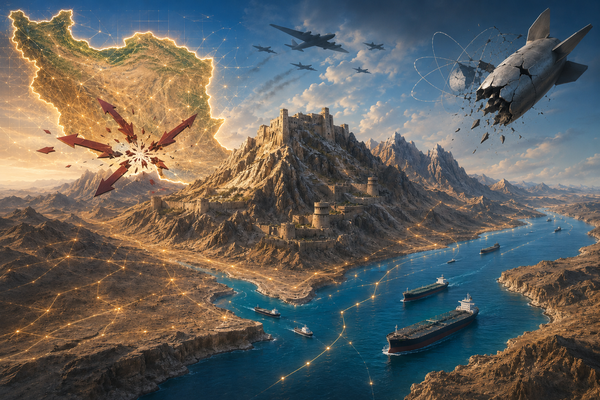
Unlike most other nation states in the Middle East, Iran (known as Persia before 1935) is not an artificial construct. By race, religion, and social history, it is a nation. European bureaucrats didn’t dream up Iran by drawing zigzags on a map. The map reflects the geographic reality of a country with natural, fortress-like mountain borders. In the east, the Roman Empire generally ended where the Persian Empire began.
Iran has powerful friends throughout the Middle East—like the Houthis in Yemen, Hezbollah in Lebanon, and various Iraqi militias—who are willing to fight.
Further, Iran is Russia’s and China’s key ally in the Middle East. A US-aligned government in Tehran could help block China’s Belt and Road Initiative from pushing farther west and potentially cut off 14% of China’s oil imports. It would also hinder Russian trade through the Caspian Sea and serve as a launchpad for destabilizing Russia from its southern flank.
In short, bringing Iran under US influence would open the door to further undermining both Russia and China. For these two great powers, Iran is strategic depth. Russia and China cannot afford to let Iran fall. So I wouldn’t be surprised to see Russia and China support Iran with intelligence, weapons, supplies, and other forms of assistance that would make the conflict even more costly for the US.
Most importantly, just look at Iran’s topography. Similarly, Switzerland’s rugged mountainous terrain has helped protect it from invasion for centuries. And Iran (1,630,848 sq km) is not just the size of Switzerland (41,291 sq km), but the equivalent of roughly 40 Switzerlands.
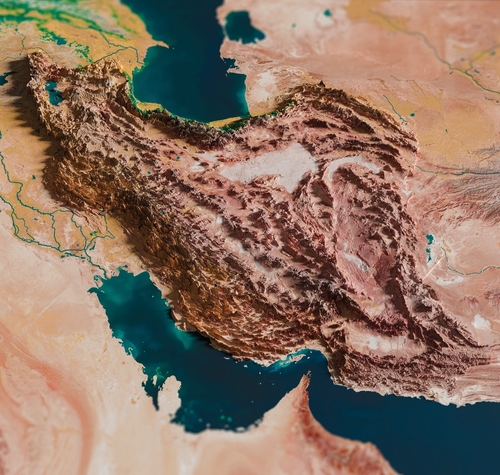
When you consider all the factors, it becomes clear that a full-scale ground invasion of Iran is simply not workable.
But that doesn’t mean the US won’t try.
For argument’s sake, let’s say the US successfully invades and captures the coastline and islands around Hormuz. That still wouldn’t stop Iran from using its ballistic missiles from further inland to destroy oil infrastructure across the Persian Gulf. Even if the US managed to reopen the Strait, Iran could ensure there was nothing left to export, making the effort moot.
Here’s the bottom line: regardless of what the US does, Iran is likely to retain control over Hormuz.
Could the US or Israel Use Nuclear Weapons on Iran?
Faced with the bleak prospects of a successful ground invasion, the US (or Israel) could resort to using nuclear weapons.
Iran is well aware that the US or Israel could use nuclear weapons against it. It has contingency plans for that outcome to ensure the survival of its government. Iran’s plans also likely include making a dash for developing its own nuclear arsenal to be able to respond in kind.
Further, it’s doubtful that Russia and China would just sit back and do nothing if the US and Israel looked like they might nuke Iran. For example, Russia could decide to station nuclear weapons and Russian soldiers on Iranian soil as a deterrent.
Suppose the US and Israel used nuclear weapons on Iran. It would shatter the global taboo and effectively give other countries the green light to use them. Could Russia then nuke Ukraine or another part of Europe? Could China nuke Taiwan? What about India and Pakistan?
I was on a private call recently with a former US Army Special Forces veteran, who is very well-connected and knowledgeable about the situation.
He said that if the US or Israel nukes Iran, there is a good chance Russia and China will immediately nuke the US and Israel with everything they have out of fear of being next. There is no such thing as “limited” nuclear war. Once the nukes start flying, the incentive is to “use it or lose it.”
Using nukes on Iran with the hope that it would remain “limited” would be rolling the dice with the future of mankind.
The consequences of the US or Israel nuking Iran would be catastrophic. It could trigger a chain reaction that threatens life on Earth. And while it is unlikely, in my view, because of the possibility that mutually assured destruction will lead to deterrence, it remains a real possibility—just not what I would consider the base-case scenario.
The conflict with Iran is not just a military crisis. It is a warning sign of something much larger.
A prolonged war, a shutdown of Hormuz, a spike in oil prices, or a reckless escalation involving nuclear weapons would not stay contained in the Middle East. It would ripple through energy markets, supply chains, currencies, inflation, and the global financial system.
In other words, the risks are not just geopolitical. They are personal.
They could affect your savings, your purchasing power, your investments, and your freedom.
That is why I prepared a free special report: The Most Dangerous Economic Crisis in 100 Years… the Top 3 Strategies You Need Right Now.
Inside, you’ll discover what the mainstream media won’t tell you about the crisis now unfolding… how today’s economic, political, and cultural trends could threaten your money and personal freedom… and the top three strategies you need to prepare now.