Most people have medical, life, fire, and car insurance.
You hope you never need them—but you get them anyway. Why? Because they offer peace of mind and protect you if and when the worst happens.
International diversification is the ultimate insurance policy against an out-of-control government. I call it “freedom insurance.”
It frees you from total dependence on any one country. Once you have that freedom, it becomes very difficult for any group of bureaucrats to control you.
The results can be liberating.
You know the benefits of diversifying your investment portfolio. If you put all of your asset eggs in one basket, you could lose your entire portfolio if that basket breaks.
The same logic applies to political risk—the risk your government poses to your personal and financial well-being.
If your home country “breaks”—as Russia did in the 1920s or Germany in the 1930s—you could lose everything.
And make no mistake: that risk is rising in the US, Europe, Canada, the UK, Australia, New Zealand, and across the Western world. That’s why securing Freedom Insurance now is essential.
For centuries, the wealthy have used international diversification to protect their money and families. It’s about strategically placing the different parts of your life in the best jurisdictions possible—to maximize freedom and financial opportunity.
While there are several core areas to consider, obtaining a second passport is a crucial piece of the puzzle.
Among other things, having a second passport allows you to invest, bank, travel, live, and do business in places you wouldn’t otherwise be able to.
But there’s another critical reason to get a second passport. Remember, your passport doesn’t belong to you. It belongs to the government, and it can cancel your passport at any moment under any pretext it finds convenient.
Having a second or third passport means that your home government can’t arbitrarily restrict your ability to travel.
Unfortunately, there is no route to a genuine second passport that is fast, easy, and cheap. Deciding the best place and way to get one is not necessarily straightforward. There is no one-size-fits-all solution.
But today, I’ll show you the path of least resistance.
It helps to view the whole world as your hunting ground. So don’t dismiss the idea of becoming a citizen of a small or backward country. Unlike countries with mega-governments, these places generally lack the capacity and desire to monitor their citizens or treat them as milk cows.
How to Get a Second Passport: The Four Roads
There are exactly four legitimate routes to a valid second citizenship and passport. So if you hear about a fifth route, it’s prudent to presume it’s a scam.
Following bad advice can create significant problems and limit your options. Instead, your goal should be minimizing problems and expanding your opportunities.
To find the best route, start with the decision tree below (click to enlarge).
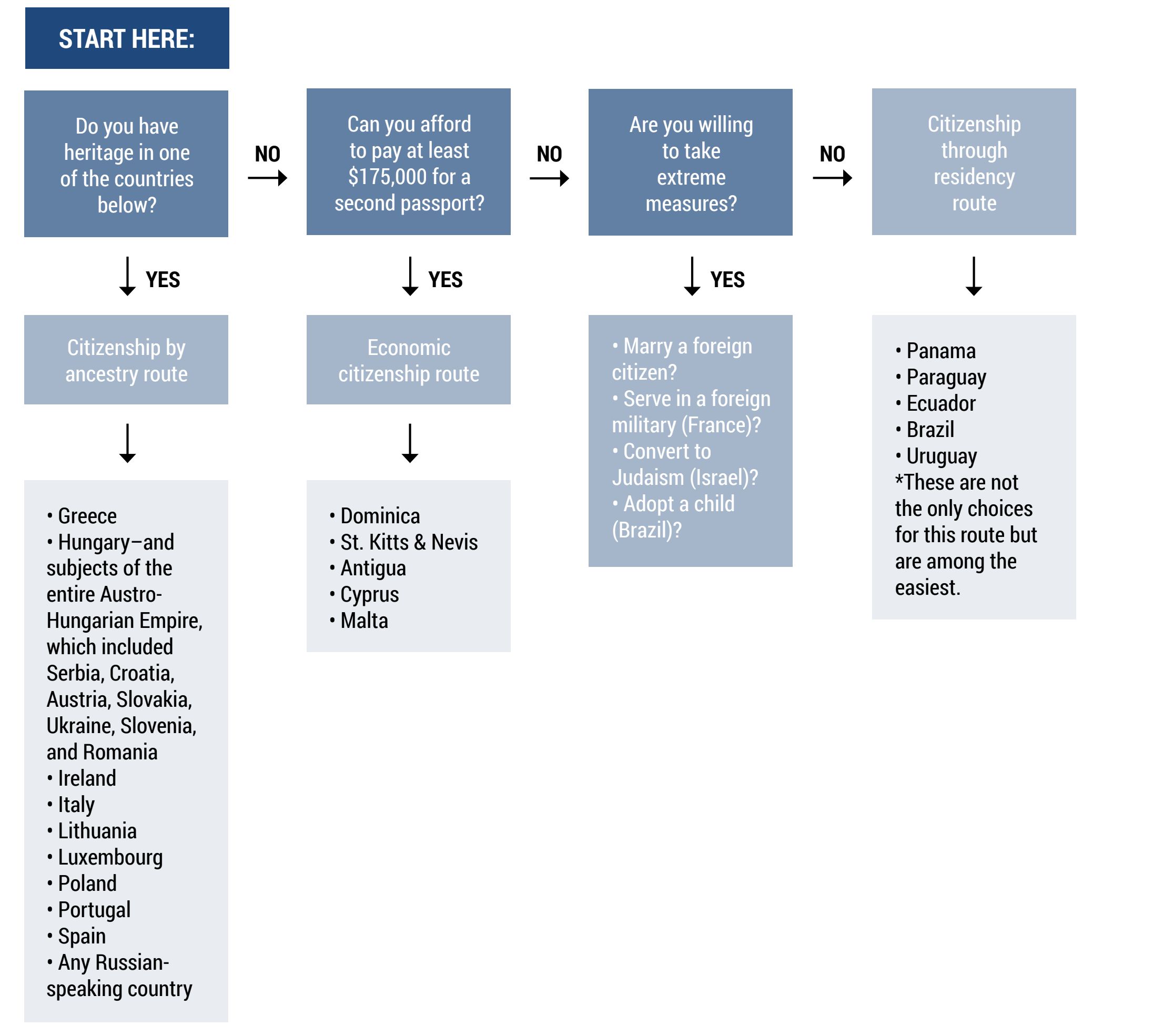
No matter which path you take, make sure to reference official sources—government, consulate, or embassy websites. You should be able to point to clear laws and requirements in black and white.
Route #1: Citizenship by Ancestry
If you qualify, this is the cheapest and often most straightforward route.
Many countries offer citizenship if you can prove descent from a parent, grandparent, or sometimes even a great-grandparent. Requirements vary by country.
This process usually starts at the consulate of the relevant country. Check their website for eligibility details and documentation requirements.
Route #2: Economic Citizenship Programs
This is the fastest route—but also the most expensive.
Economic citizenship means you make a large donation or investment, and in return, the government grants you citizenship—often in just a few months.
You don’t have to live there. You don’t even have to visit, in some cases.
Currently, Dominica and St. Kitts & Nevis (both English-speaking Caribbean nations) offer the only long-standing, stable programs worth considering.
A passport from either country gives you visa-free access to most of Latin America, the Caribbean, and much of Europe.
Other countries also offer economic citizenship programs. But they haven’t been around nearly as long as the Dominica (1993) and St. Kitts (1983) programs.
A reliable and stable history is essential. Ultimately, any government can revoke the passport and citizenship of its citizens at any time for any reason, real or concocted.
A shift in the political winds could mean that an economic citizenship program in favor today could be out of favor tomorrow. That could have negative consequences for foreigners who participated in the program.
Only the St. Kitts and Dominica programs have stood the test of time (decades), with thousands of people successfully using them.
Route #3: Extreme Measures
If you’re willing to take extreme measures, there are shortcuts.
You could marry a foreigner. Many countries will grant citizenship to foreign spouses after some time, usually at least two years.
France grants citizenship upon completion of military service.
Jews are eligible for Israeli citizenship. However, in most cases, military service is required.
Brazil offers a shortcut to citizenship for those who adopt a child or parents of children born in the country.
These are real options—but not for everyone. And most come with serious commitments.
Route #4: Naturalization Through Residency
So, if the family bloodline leads to a dead end… and you aren’t willing to marry a foreigner, serve in a foreign military, or take any other extreme measures… and you can’t afford an economic citizenship program… the last route is permanent residency.
Most countries will grant citizenship after you’ve lived there for five or more years as a legal resident. Some are faster. Others take longer.
The rules vary—and they change often.
Some countries require you to live full-time and integrate into the culture. Others are more relaxed.
Key factors to consider:
- Required residency period
- Minimum time required in-country during the residency period
- Costs and mandatory investments
- Language or cultural integration requirements
If you’re committed and patient, this path can absolutely work.
A Crucial Step
The “easiest” route to a second passport depends entirely on your circumstances—family history, budget, lifestyle, and risk tolerance.
It’s not a fun process any way you slice it, but that should not dissuade you. The benefits far outweigh the costs.
As the political and economic situation continues to deteriorate in the US, Europe, and elsewhere, a second passport becomes more than just a luxury—it becomes a necessity.
Fortunately, there are numerous options to obtain a second passport or residency. However, the menu of options is constantly changing, and there is no one-size-fits-all solution.
Want to know the easiest countries to get a second passport?
We just released a free guide breaking it all down—click here to download the PDF now.