The dam finally broke…
President Biden recently announced the federal government is initiating an expedited review of marijuana’s status as a Schedule 1 drug—the most severe category of illegal drugs.
It marks the most significant move to end federal cannabis prohibition.
For decades, the US federal government has considered cannabis more dangerous than cocaine and meth—and now fentanyl—putting the plant in the same category as heroin.
The good news is this ridiculous policy won’t last much longer.
After the federal government completes its expedited review, there’s an excellent chance the US will move cannabis to a lower classification schedule. It’s also possible they could de-schedule cannabis and remove its status as a controlled substance. That would mean the end of federal cannabis prohibition.
No matter what ultimately happens, it’s clear prohibition’s days are numbered.
At a minimum, we are looking at a significant softening of federal prohibition and eventual legalization. Or, quite possibly, the imminent end of federal prohibition altogether.
The implications of that are profound.
Most investors haven’t connected the dots—which is why there is such a big opportunity today.
Remember, the US government is the central pillar that has upheld the global cannabis prohibition regime for nearly 80 years. However, it is now crumbling at an accelerating rate.
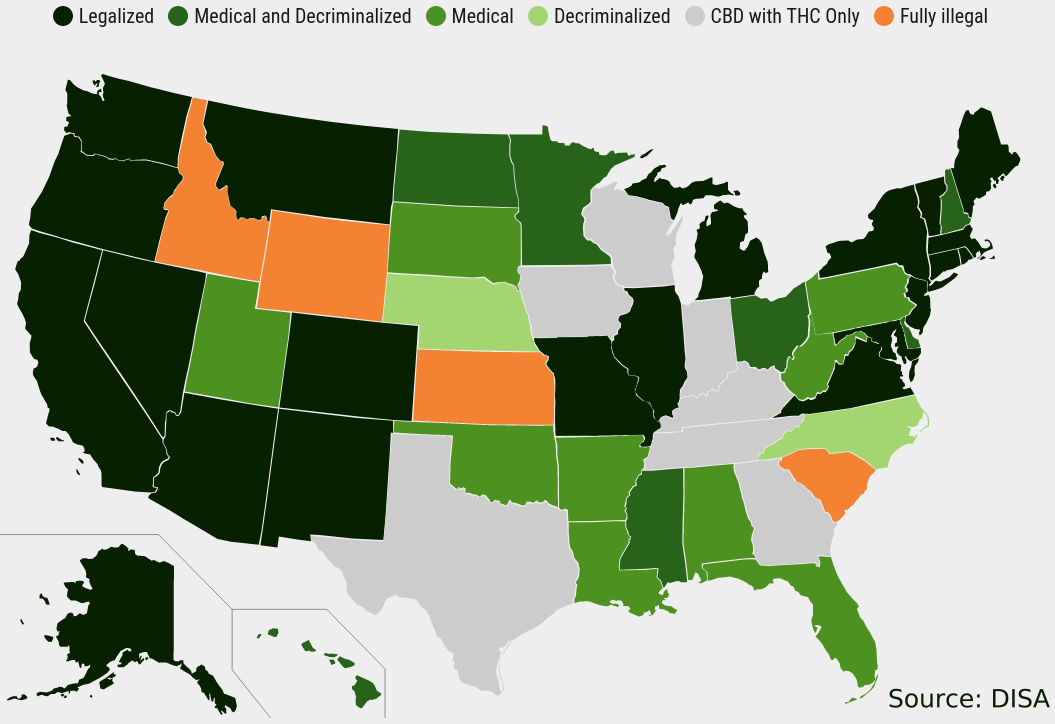
Cannabis is now totally legal in 21 states and the District of Colombia. Medicinal use is legal in 37 states.
A further 11 states have decriminalized cannabis, which means that although it is not entirely legal, local governments treat it as an administrative offense rather than a criminal one.
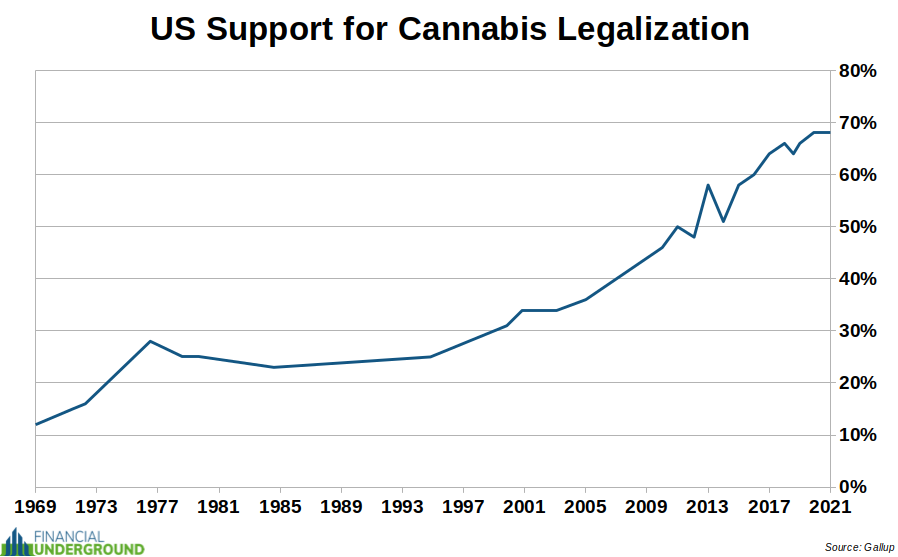
Support for cannabis legalization in the US is at an all-time high of 68%, including over 50% of Republicans, who were traditionally opposed to ending prohibition.
By contrast, the Canadian government fully legalized cannabis in 2018 when it had the support of 68% of Canadians.
Once federal prohibition ends in the US, I expect most of the world will quickly legalize cannabis too. Naturally, everybody will want to cash in on what could become the world’s fastest-growing consumer industry.
We are already seeing that happen. For example, Germany, the largest economy in the EU, announced recently that the country aims to legalize recreational cannabis.
According to Forbes, which cited BDSA, a top cannabis market research firm, the global legal cannabis market is worth about $30 billion. However, that is just a tiny fraction of what the illicit market could be.
The United Nations estimates there are 209 million cannabis users worldwide.
If we presume that each consumer spends $10/week on average on cannabis products—which I think is a conservative assumption—we can estimate the global cannabis market, legal and illicit, to be worth at least $108 billion annually.
Other estimates are much higher. For example, some credible analysts believe the global cannabis market is worth up to $415 billion.
The truth is, nobody knows how big the global cannabis market is today, never mind the total addressable market once prohibition ends.
I am confident it’s much bigger than most people imagine and will be bigger than the combined legal and illicit markets.
Imagine what all the industries that cannabis touches would look like had they developed in a free market—without an 80-year global prohibition—and then think about where we are today.
For example, prohibition has needlessly stunted the research and study of cannabis’ obvious medicinal properties. I have little doubt new research will unlock lucrative new medical applications and pharmaceuticals in the months and years ahead.
Legal cannabis will also create numerous new categories of consumer products, like cannabis-infused beverages, for example. Big Alcohol companies are already partnering with cannabis companies to develop beverages that could have zero calories and no hangover.
It reminds me of when Red Bull created energy drinks, an entirely new category of consumer products. Today, according to some estimates, the global market for energy drinks is worth about $46 billion.
Red Bull is a private company. But Monster Beverage, its closest energy drink competitor, is publicly-traded.
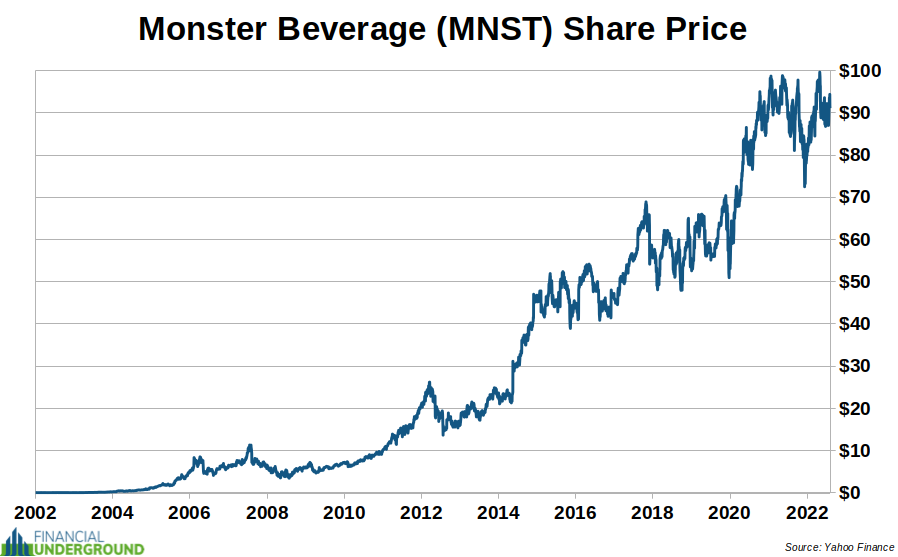
In April 2002, Monster launched its famous energy drink, and its share price skyrocketed from $0.09 to a peak of over $99. That’s more than a 1,100-fold gain, or 112,412% to be exact.
In other words, a $1,000 investment could have exploded into more than $1.1 million—had someone been able to pick the bottom and top perfectly. Of course, that is not realistic, but as we can see in the chart below, even being within a year of the absolute bottom and top would have been enough to generate some phenomenal returns.
The rare and unique example of Monster is worth noting because it illustrates the power of getting in on a big trend early before the crowd understands what is happening—like the birth of new industries.
However, Monster was the best example I could find. Not every energy drink company was a big winner. And past performance is not an indication of future results for any investment.
And then there are the industrial applications of cannabis, which are centered around hemp. According to a study the US Congress commissioned, there are around 25,000 hemp-based products—clothing, food and beverages, cosmetics, paper, fibers, and so forth.
It’s hard to wrap your mind around the enormity of the impact the end of cannabis prohibition will have on the world. It’s a truly unprecedented situation.
It’s exponentially more profound than the repeal of alcohol prohibition in 1933. Remember, alcohol was just about recreational use. Cannabis has significant medical, recreational, industrial, and therapeutic uses. It also probably has uses we don’t even know of yet.
That being said, the legal cannabis trend is no longer in its infancy.
At this stage, Big Business is already well-established in the legal cannabis market, including most big alcohol and tobacco companies.
However, this megatrend is far from over…
This long-term story will culminate in the global legalization of cannabis and the emergence of new industries—medical, recreational, industrial, therapeutic, and accessory—worth hundreds of billions of dollars.
Any one of those is a huge industry by itself. But, combined, we’re talking about the emergence of a new global market that could easily become larger than alcohol and tobacco.
Today, we can buy the future Coca-Cola, Philip Morris, and Amazon of legal cannabis… before they emerge as industry dominators.
The federal legalization of cannabis in the US will be the turning point, and it could be imminent.
The right cannabis companies could go up 10x (or more) as they secure a slice of this growing market.
Why Most Cannabis Stocks Are Junk
I’m only interested in the rare cannabis company that has a sustainable competitive advantage and is building an actual business that can compete in a cut-throat global market—the future titans of the global cannabis industry.
There aren’t many of these companies… in fact, I would only buy one cannabis stock today (more below).
I’ve been following this industry for many years and was among the first analysts to cover publicly-traded cannabis stocks in 2017, earlier in my investment research career.
There’s an excellent chance most of the public and private cannabis companies will dry up and disappear in the months ahead.
There are four reasons why I am not interested in 99% of cannabis cultivators.
First, the barrier to entry to producing dried cannabis is low. From a practical standpoint, just about anyone can grow a cannabis plant on his back porch. It is called “weed” for a reason after all.
Second, governments impose high taxes and burdensome regulations that are expensive to comply with.
Third, black-market producers don’t pay taxes or comply with regulations. As a result, they can and do undercut legal businesses.
Fourth, for the most part, cannabis production is not about product differentiation like the wine industry, for example. Instead, it’s about bulk-scale production at the lowest cost possible, like wheat, soybeans, and other agricultural commodities—but cannabis has significantly more regulations.
That’s why legal cannabis cultivation is a terrible business, and most companies in this space have abysmal financials. But despite their lack of business potential, many of these stocks had previously soared during the initial excitement of legalization several years ago.
That excitement has now worn off as the fundamentals have asserted themselves. As a result, many cannabis companies have seen their stocks tank over 80% from their previous peaks.
Gone are the days when you could invest in companies that didn’t have a competitive advantage and make easy profits.
Now, that doesn’t mean there aren’t still big profits to be made in the legal cannabis megatrend. It’s just going to be with companies that can build real businesses based on sustainable competitive advantages.
Global cannabis legalization is just one investment trend I am following closely for 2023. Several others could be even more profound.
A dangerous combination of sky-high debt, endless money printing, and significant cultural and social shifts are sweeping through the West.
There will likely be unprecedented volatility of every kind in the months ahead.
That’s why I just released an urgent free PDF report:
The Most Dangerous Economic Crisis in 100 Years… the Top 3 Strategies You Need Right Now